Share Your Screen - Android
-
A participant can share their complete mobile screen with the other participants in a meeting.
-
This guide shows how to enable or disable screen share in a meeting.
How Screen share works?
- The following diagram shows the flow of screen sharing on Android with VideoSDK:
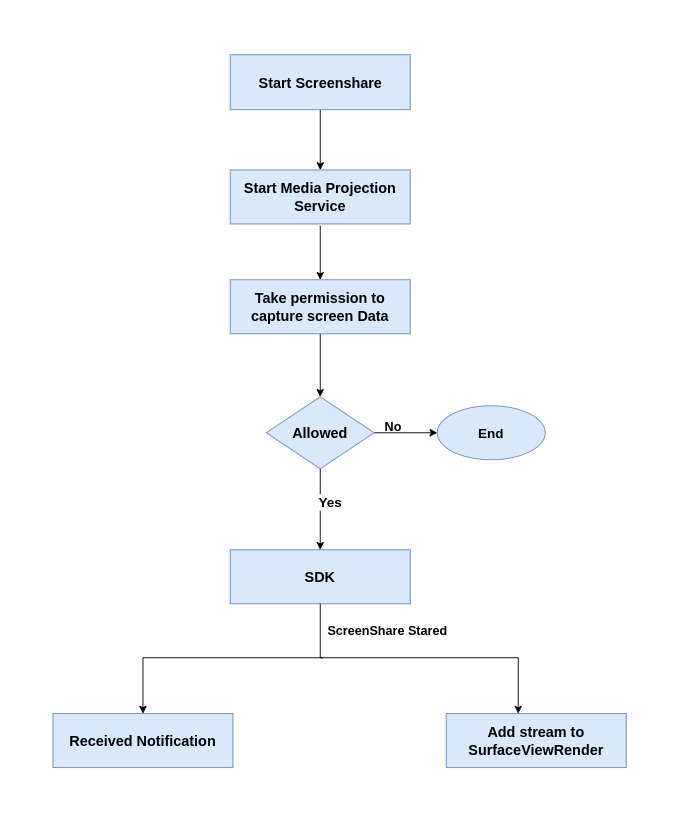
Enable Screen Share
-
A participant’s Screen share stream is provided via the Android
MediaProjectionAPI. -
Get an instance of the
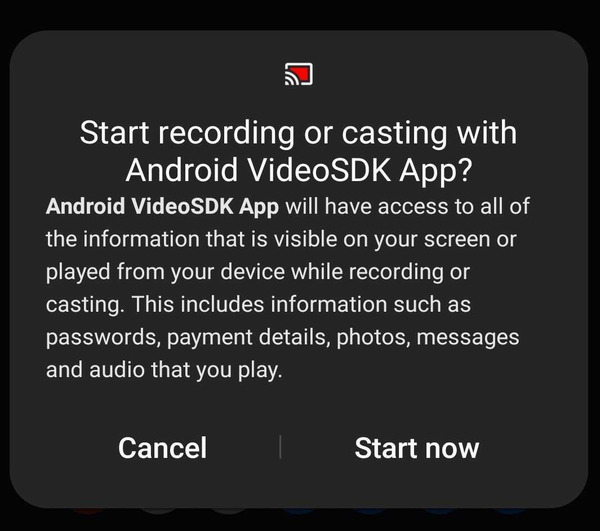
MediaProjectionManagerand call thecreateScreenCaptureIntent()method in an activity. This initiates a prompt dialog for the user to confirm screen projection. -
The user sees a prompt dialog like this:
- After permission is received from the user, call
meeting.enableScreenShare()method. It is asuspendfunction, so call it from a coroutine. It throwsVideoSDKExceptionwhen the share can't start, for example3054when the screen is already being shared.
private fun enableScreenShare() {
    val mediaProjectionManager = application.getSystemService(
        MEDIA_PROJECTION_SERVICE
    ) as MediaProjectionManager
    startActivityForResult(
        mediaProjectionManager.createScreenCaptureIntent(), CAPTURE_PERMISSION_REQUEST_CODE
    )
}

public override fun onActivityResult(requestCode: Int, resultCode: Int, data: Intent?) {
    super.onActivityResult(requestCode, resultCode, data)
    if (requestCode != CAPTURE_PERMISSION_REQUEST_CODE) return
    if (resultCode == RESULT_OK && data != null) {
        lifecycleScope.launch {
            try {
                meeting.enableScreenShare(data)
            } catch (e: VideoSDKException) {
                Log.e("VideoSDK", "Screen share failed: ${e.code} ${e.name}")
            }
        }
    }
}
-
enableScreenShare(data)shares the screen with theh720p_15fpsencoder profile. To choose another profile, use a custom screen share track. -
To share the device's audio along with the screen, call
meeting.enableScreenShare(data, enableAudio = true). The audio is mixed into your microphone audio, so muting the mic also mutes it. This needs Android 10 (API 29) or later and theRECORD_AUDIOpermission.
Screen share notification
-
When a presenter starts screen share, the presenter receives an ongoing notification for as long as the screen is shared.
-
On Android 13 (API 33) and later, the notification shows in the notification drawer only if your app has been granted the
POST_NOTIFICATIONSpermission. The share works either way. -
If the presenter removes the app from the recent apps screen during a share, the share ends.
Disable Screen Share
By using meeting.disableScreenShare() function, a participant can stop publishing screen stream to other participants. It is a suspend function, so call it from a coroutine.
private fun disableScreenShare() {
    lifecycleScope.launch {
        try {
            meeting.disableScreenShare()
        } catch (e: VideoSDKException) {
            Log.e("VideoSDK", "Stop screen share failed: ${e.code} ${e.name}")
        }
    }
}
Display Screen Share Stream
Local Participant
When the local participant shares the screen, onStreamEnabled() of ParticipantEventListener is triggered with the Stream which can be added to a VideoView.
import videosdk.org.webrtc.VideoTrack

private fun setLocalListeners() {
    meeting.localParticipant.addEventListener(object : ParticipantEventListener() {
        override fun onStreamEnabled(stream: Stream) {
            if (stream.kind.equals("share", ignoreCase = true)) {
                // display share video
                val videoTrack = stream.track as? VideoTrack ?: return
                shareView.addTrack(videoTrack)
            }
        }
        override fun onStreamDisabled(stream: Stream) {
            if (stream.kind.equals("share", ignoreCase = true)) {
                shareView.removeTrack()
            }
        }
    })
}
Other Participants
When any participant starts sharing their screen, onPresenterChanged() in the MeetingEventListener is triggered with their participantId. This includes your own share; the code below skips it, because meeting.participants holds only the other participants. When the screen share stops, it is triggered with null.
import videosdk.org.webrtc.VideoTrack

private val meetingEventListener: MeetingEventListener = object : MeetingEventListener() {
    override fun onPresenterChanged(participantId: String?) {
        updatePresenter(participantId)
    }
}

//Getting the stream from the participantId
private fun updatePresenter(participantId: String?) {
    // null means nobody is sharing
    if (participantId == null) return

    // find participant
    val participant = meeting.participants[participantId] ?: return

    // find share stream in participant
    var shareStream: Stream? = null
    for (stream: Stream in participant.streams.values) {
        if ((stream.kind == "share")) {
            shareStream = stream
            break
        }
    }
    if (shareStream == null) return

    // display share video
    val videoTrack = shareStream.track as? VideoTrack ?: return
    shareView.addTrack(videoTrack)

    // listen for share stop event
    participant.addEventListener(object : ParticipantEventListener() {
        override fun onStreamDisabled(stream: Stream) {
            if ((stream.kind == "share")) {
                shareView.removeTrack()
            }
        }
    })
}
- Here screenShare stream is displayed using
VideoView. The WebRTC classes, such asVideoTrack, come from thevideosdk.org.webrtcpackage. - To know more about
VideoView, please visit here
Got a Question?  Ask us on discord

