Optimize Video Tracks - Javascript
To optimize the viewing experience, it's essential to fine-tune the video tracks used during calls.
For an enhanced fine-tuning experience, we've introduced the capability to provide a custom video track for a participant's media before and during the meeting.
This page uses the following asynchronous methods. Refer to their API reference for the errors each Promise may reject with, and handle these rejections appropriately based on your use case.
Custom Video Track
This feature allows you to incorporate custom video encoder configurations, choose optimization modes (focusing on motion, text or detail of the video), specify a modern video quality profile (bitrateMode), and control simulcast behavior (maxLayer), and apply background removal and video filters from external libraries (e.g., videosdk-media-processor), then send these modifications to other participants.
Once you set a custom video track created using createCameraVideoTrack(), VideoSDK remembers its settings and automatically reuses them whenever the webcam is turned back on. To change the track configuration, pass a new track created using createCameraVideoTrack() to changeWebcam(). VideoSDK preserves only tracks created using createCameraVideoTrack(). Filters applied through external libraries such as videosdk-media-processor are not preserved and must be re-applied each time the webcam is re-enabled. Read more in Track configuration is preserved.
How to Create a Custom Video Track ?
- You can create a Custom Video Track using
createCameraVideoTrack(). - This method can be used to create video track by specifying parameters like video resolution, camera facing mode, and the quality controls (
bitrateModeandmaxLayer). - You can choose video resolution from the below mentioned list of values for the encoder config:
| Encoder Config | Resolution | Frame Rate | Optimized (kbps) | Balanced (kbps) | High Quality (kbps) |
|---|---|---|---|---|---|
| h90p_w160p | 160x90 | 15 fps | 60 | 100 | 150 |
| h180p_w320p | 320x180 | 15 fps | 100 | 150 | 250 |
| h216p_w384p | 384x216 | 15 | 120 | 200 | 350 |
| h360p_w640p | 640x360 | 20 | 200 | 400 | 600 |
| h540p_w960p | 960x540 | 25 | 350 | 550 | 800 |
| h720p_w1280p | 1280x720 | 30 | 1000 | 1500 | 2000 |
| h1080p_w1920p | 1920x1080 | 30 | 1600 | 2200 | 2700 |
| h1440p_w2560p | 2560x1440 | 30 | 5000 | 5500 | 6000 |
| h2160p_w3840p | 3840x2160 | 30 | 8000 | 8500 | 9000 |
| h120p_w160p | 160x120 | 15 | 60 | 100 | 150 |
| h180p_w240p | 240x180 | 15 | 100 | 150 | 250 |
| h240p_w320p | 320x240 | 15 | 120 | 200 | 350 |
| h360p_w480p | 480x360 | 20 | 200 | 400 | 600 |
| h480p_w640p | 640×480 | 25 | 300 | 500 | 700 |
| h540p_w720p | 720×540 | 30 | 350 | 550 | 800 |
| h720p_w960p | 960×720 | 30 | 900 | 1300 | 1600 |
| h1080p_w1440p | 1440×1080 | 30 | 1600 | 2200 | 2700 |
| h1440p_w1920p | 1920×1440 | 30 | 3500 | 4000 | 4500 |
Above mentioned encoder configurations are valid for both, landscape as well as portrait mode.
Example
let customTrack = await VideoSDK.createCameraVideoTrack({
  // It will be the id of the camera from which the video should be captured.
  cameraId:"camera-id", // OPTIONAL

  // We will discuss this parameter in next step.
  optimizationMode: "motion", // "text" | "detail",  Default : "motion"

  // This will accept the resolution (height x width) of video you want to capture.
  encoderConfig: "h540p_w960p", // "h360p_w640p" | "h720p_w960p" ... // Default : "h720p_w1280p"

  // For Mobile browser It will specify whether to use front or back camera for the video track.
  facingMode: "environment", // "front",  Default : "environment"

  // We will discuss this parameter in next step.
  multiStream:true, // false,  Default : true

  // Optional: This controls the video quality and bandwidth usage.
  bitrateMode: VideoSDK.Constants.BitrateMode.HIGH_QUALITY, // "BANDWIDTH_OPTIMIZED" | "BALANCED" , Default : BALANCED

  // Optional: This specifies the maximum number of simulcast layers (maxLayer) to publish.
  maxLayer: 2, // 3 , Default: 3

  // Optional: This specifies the video codec used to encode this track.
  codec: VideoSDK.Constants.VideoCodec.VP8 // "H264" | "VP9" | "AV1" , Default : VP8
});
The behavior of custom track configurations is influenced by the capabilities of the device. For example, if you set the encoder configuration to 1080p but the webcam only supports 720p, the encoder configuration will automatically adjust to the highest resolution that the device can handle, which in this case is 720p.
What is optimizationMode?
-
This parameter specifies the optimization mode for the video track being generated.
-
motion: This type of track focuses more on motion video such as webcam video, movies or video games.- It will degrade
resolutionin order to maintainframe rate.
- It will degrade
-
text: This type of track focuses on significant sharp edges and areas of consistent color that can change frequently such as presentations or web pages with text content.- It will degrade
frame ratein order to maintainresolution.
- It will degrade
-
detail: This type of track focuses more on the details of the video such as, presentations, painting or line art.- It will degrade
frame ratein order to maintainresolution.
- It will degrade
What is multiStream?
- This parameter specifies whether the stream should send multiple resolution layers or a single resolution layer. It is
trueby default.
Refer to the Simulcast (Adaptive Bitrate) guide for the layers a track publishes and for how participants select the layer they receive.
What is BitrateMode?
BitrateMode is the key setting for video quality. It lets you decide whether to prioritize sharp details, save internet data, or find a good balance between the two.
You can choose from three distinct modes:
bandwidth_optimized: Prioritizes lower bandwidth usage over video quality. Ideal for users with poor or unstable network conditions.balanced: The default setting. It provides a smart compromise between clear video and efficient bandwidth consumption, suitable for most use cases.high_quality: Prioritizes video quality over bandwidth usage. Use this when high-fidelity video is essential and viewers are expected to have strong network connections.
What is maxLayer?
- This parameter caps how many layers a track publishes, and accepts
2or3. It applies only whenmultiStreamistrue, and defaults to3.
Refer to the Simulcast (Adaptive Bitrate) guide for what each value publishes.
What is codec?
- This parameter specifies the video codec used to encode your stream. VideoSDK supports
VP8(default),H264,VP9, andAV1, set throughVideoSDK.Constants.VideoCodec. - Currently, VideoSDK doesn't support
multiStreamforVP9andAV1.multiStreamdefaults totrue, so setmultiStream: falsewhen you create aVP9orAV1track. Otherwise VideoSDK sets it tofalsefor you and emits theERROR_MULTISTREAM_NOT_SUPPORTEDerror event.
Refer to the Video Codecs guide to compare the four codecs, to check which codec a meeting is actually using, and to handle the cases where a codec is not supported.
How to Setup a Custom Video Track ?
The custom track can be configured both before and after the meeting is initialized. Following are the methods that help in doing so:
- Setting up a Custom Track during the initialization of a meeting
- Setting up a Custom Track with methods
1. Setting up a Custom Track during the initialization of a meeting
If you are enabling the webcam (webcamEnabled: true) in the config of the initMeeting method and wish to use custom tracks from the start of the meeting, you can pass a custom track in the config as demonstrated below.
Custom Track will not apply on webcamEnabled: false configuration.
Example
let customVideoTrack = await VideoSDK.createCameraVideoTrack({
  optimizationMode: "motion",
  encoderConfig: "h540p_w960p",
  facingMode: "environment",
  multiStream: true,
  bitrateMode: VideoSDK.Constants.BitrateMode.HIGH_QUALITY,
  maxLayer: 2,
  codec: VideoSDK.Constants.VideoCodec.VP8,
});

// Meeting Init
meeting = VideoSDK.initMeeting({
  meetingId: meetingId, // required
  name: name, // required
  //If true, it will use the passed custom track to turn webcam on
  webcamEnabled: true,
  //Pass the custom video track here
  customCameraVideoTrack: customVideoTrack,
});
2. Setting up a Custom Track with methods
To switch tracks during the meeting, you need to pass the MediaStream in the enableWebcam() method of the meeting object.
Make sure to call the disableWebcam() method before you create a new track as it may lead to unexpected behavior.
Example
let meeting;

// Initialize Meeting
meeting = VideoSDK.initMeeting({
  // ...
});

const enableWebcamBtn = document.getElementById("enableWebcamBtn");
enableWebcamBtn.addEventListener("click", async () => {
  let customVideoTrack = await VideoSDK.createCameraVideoTrack({
    optimizationMode: "motion",
    encoderConfig: "h540p_w960p",
    facingMode: "environment",
    multiStream: true,
    bitrateMode: VideoSDK.Constants.BitrateMode.HIGH_QUALITY,
    maxLayer: 2,
    codec: VideoSDK.Constants.VideoCodec.VP8,
  });

  // Enable Webcam in Meeting
  try {
    await meeting?.enableWebcam(customVideoTrack);
  } catch (err) {
    console.error("enableWebcam failed:", err);
  }
});
Using custom video tracks is not just limited to the video tracks created using the createCameraVideoTrack method. You can use any MediaStream object as a replacement which can include a custom canvas track created by you.
Which Configuration is suitable for me ?
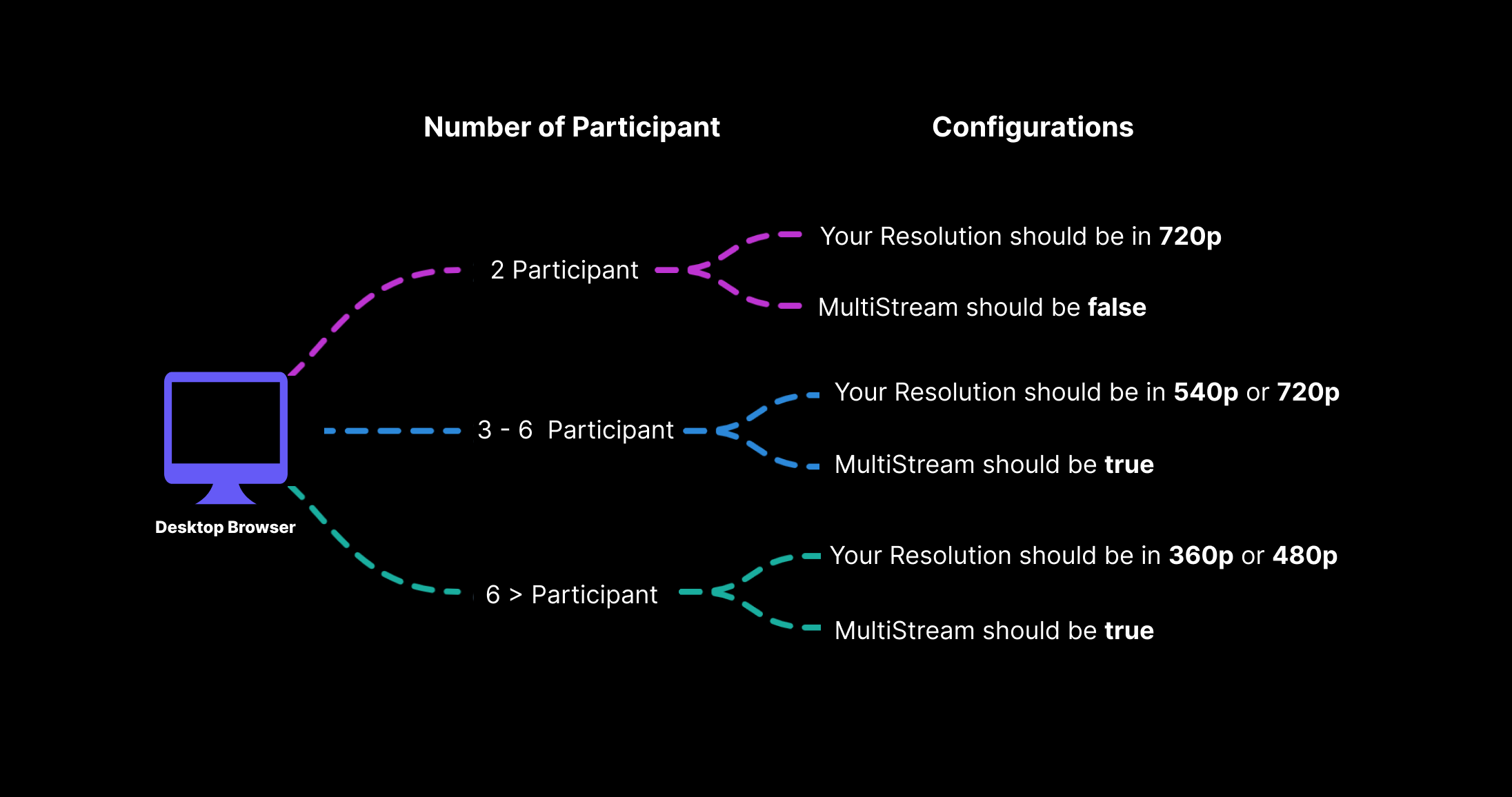
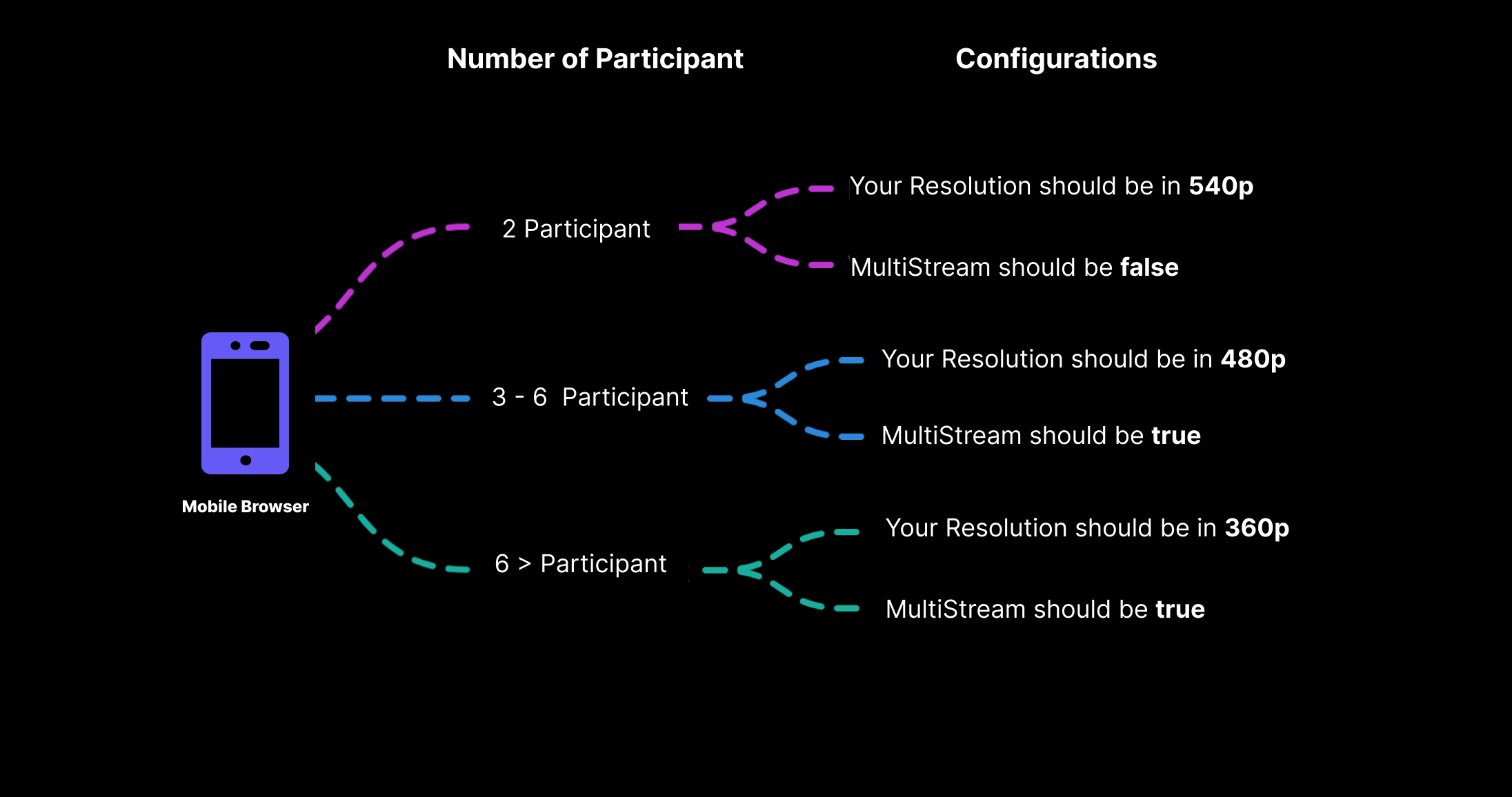
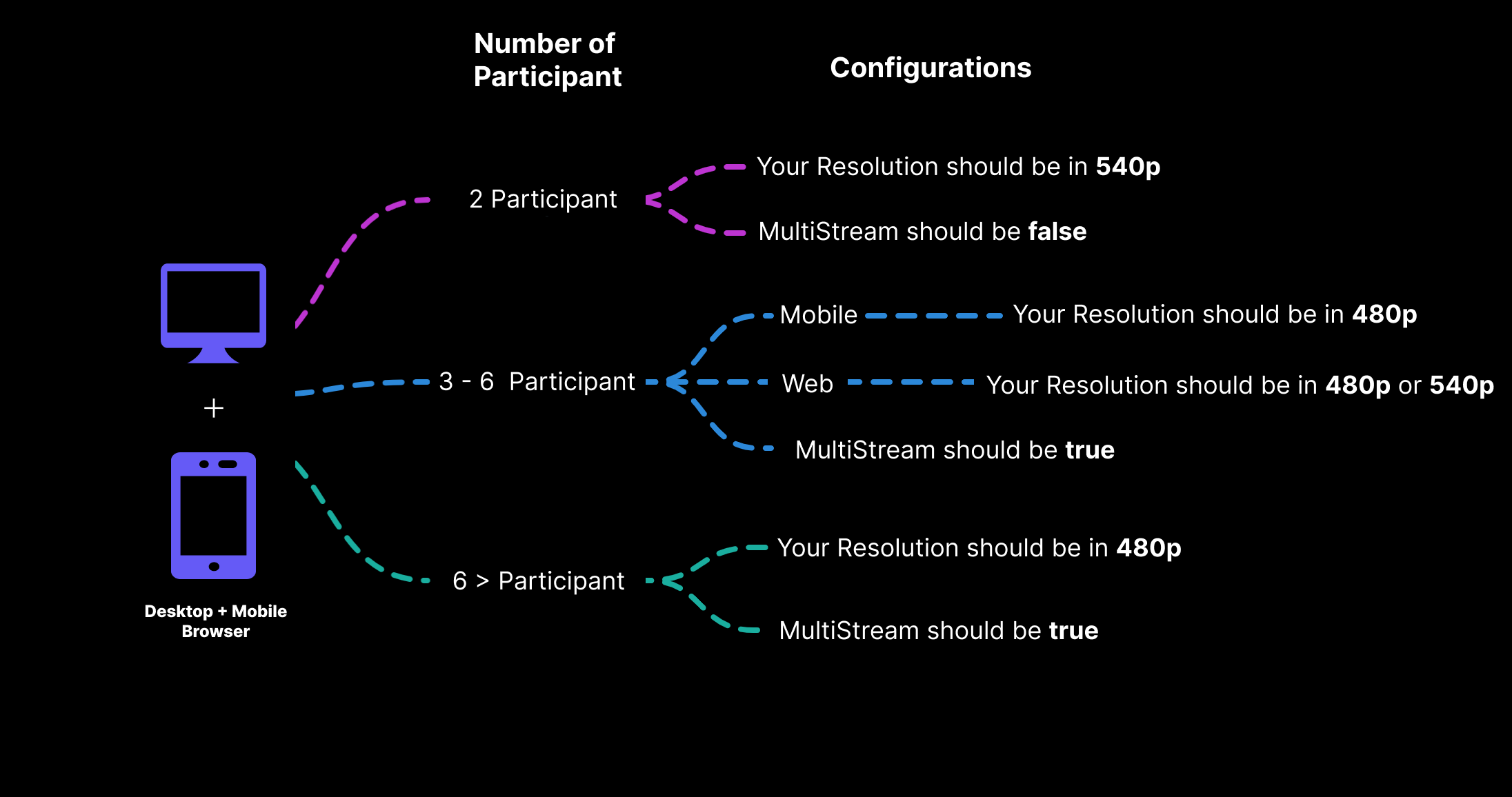
In this section, the focus is on understanding participant size and platform-wise encoder(Resolution) and multiStream configuration.
1. For Desktop Browser
2. For Mobile Browser
3. For Desktop + Mobile Browser
Custom Screen Share Track
This feature enables the customization of screenshare streams with enhanced optimization modes and predefined encoder configuration (resolution + FPS) for specific use cases, which can then be sent to other participants.
How to Create a Custom Screen Share Track ?
- You can create a Video Track using the
createScreenShareVideoTrack()method. - This method enables the creation of a video track with different encoding parameters and optimization modes.
Example
let customShareTrack = await VideoSDK.createScreenShareVideoTrack({
  optimizationMode: "motion", // "text" | "detail",  Default : "motion"

  // This will accept the  height & FPS of video you want to capture.
  encoderConfig: "h720p_15fps", //  `h360p_30fps` | `h1080p_30fps` // Default : `h720p_15fps`
});
You can learn about optimizationMode from here What is optimizationMode ?
How to Setup a Custom Screen Share Track ?
In order to switch tracks during the meeting, you have to pass the MediaStream in the **enableScreenShare() method of the meeting object.
Make sure to call disableScreenShare() before you create a new track as it may lead to unexpected behavior.
Example
let meeting;

// Initialize Meeting
meeting = VideoSDK.initMeeting({
  // ...
});

const enableScreenShareBtn = document.getElementById("enableScreenShareBtn");
enableScreenShareBtn.addEventListener("click", async () => {
  let customShareTrack = await VideoSDK.createScreenShareVideoTrack({
    optimizationMode: "motion",
    encoderConfig: "h720p_15fps",
  });

  try {
    await meeting?.enableScreenShare(customShareTrack);
  } catch (err) {
    console.error("enableScreenShare failed:", err);
  }
});
API Reference
The API references for all the methods and events utilized in this guide are provided below.
Got a Question?  Ask us on discord

