Realtime Transcription - Javascript
Realtime transcription allows you to transcribe audio content into text in real-time during a session. This guide will walk you through using the startTranscription() and stopTranscription() functions to manage realtime transcription in your application.
Moreover, VideoSDK offers flexibility in configuring real-time transcription, allowing you to set up webhooks for this purpose.
This page uses the following asynchronous methods. Refer to their API reference for the errors each Promise may reject with, and handle these rejections appropriately based on your use case.
Integrating Realtime Transcription Feature
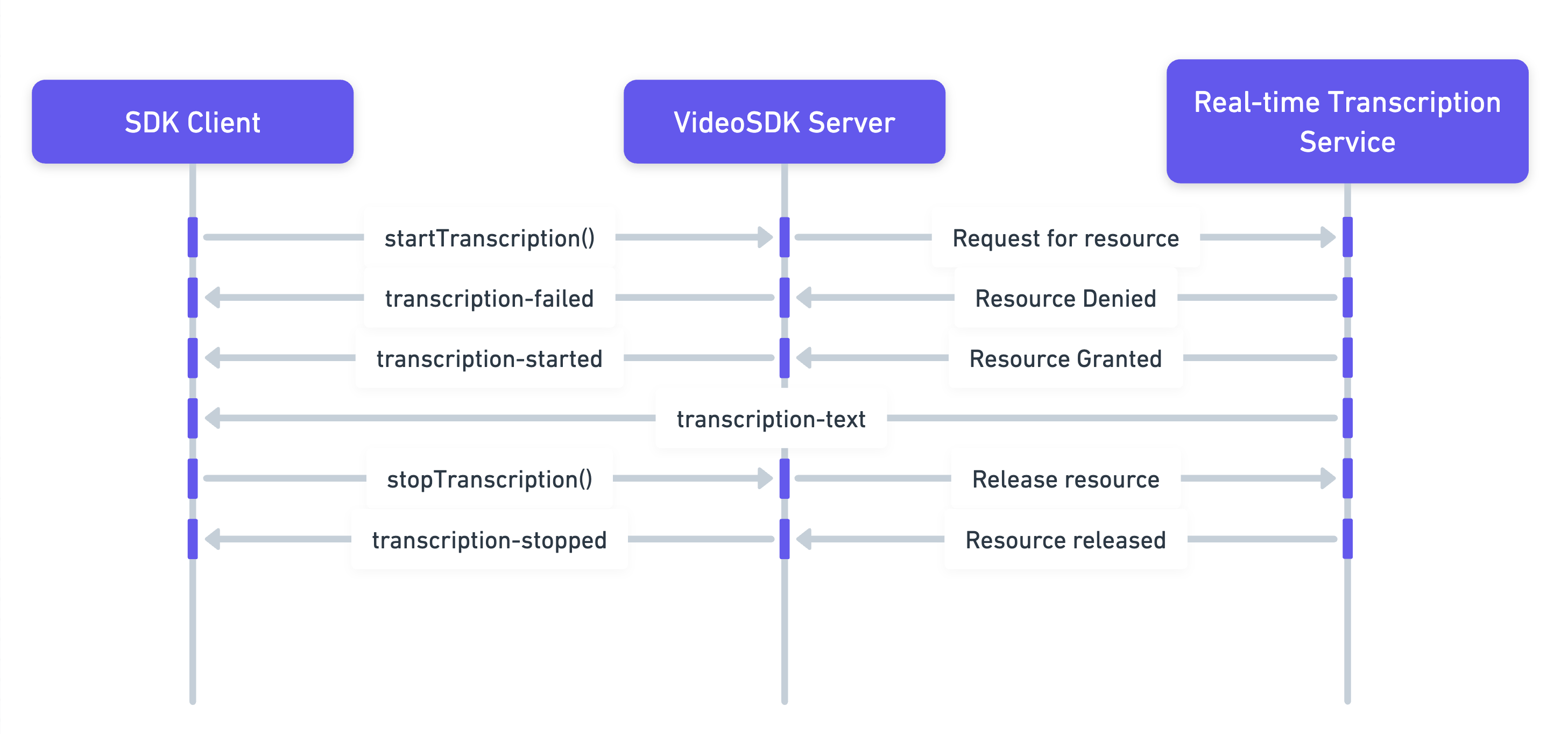
The above image represents,
-
Start Transcription: The SDK Client initiates real-time transcription using the
startTranscriptionmethod. -
Resource Acquisition: VideoSDK server requests necessary resources from transcription service.
- If the request is denied, the server sends a
transcription-failedevent to the SDK Client. - If the request is successful, the server sends a
transcription-startedevent to the client, indicating that transcription has begun.
- If the request is denied, the server sends a
-
Transcription Data: As transcription progresses, the client receives
transcription-textevent with data such as the text itself, participant ID, and timestamp. -
Stop Transcription: When the client decides to stop transcription, it informs the VideoSDK server to release resources.
- The server then sends a
transcription-stoppedevent to confirm that transcription has ended and resources are released.
- The server then sends a
Step 1: Configure Realtime Transcription
- In this step, we set up the configuration for realtime transcription. We define the webhook URL where the webhooks will be received, along with the language spoken in the session.
// Realtime Transcription Configuration
const config = {
  webhookUrl: "https://www.example.com",
  language: "en-US",
  summary: {
    enabled: true,
    prompt: "Write summary in sections like Title, Agenda, Speakers, Action Items, Outlines, Notes and Summary"
  }
};
language: The language code of the speech to transcribe. Defaults toenwhen it is not set. Refer to Supported Languages for the codes you can pass.
Step 2: Listen for the transcription events
- Here, we configure the callback methods for transcription events.
import { VideoSDK } from "@videosdk.live/js-sdk";

const Constants = VideoSDK.Constants;

// Listen for transcription state changed event
meeting.on("transcription-state-changed", (data) => {
  let { status, id } = data;

  if (status === Constants.transcriptionEvents.TRANSCRIPTION_STARTING) {
    console.log(`Realtime Transcription with ${id} is starting`);
  } else if (status === Constants.transcriptionEvents.TRANSCRIPTION_STARTED) {
    console.log(`Realtime Transcription with ${id} is started`);
  } else if (status === Constants.transcriptionEvents.TRANSCRIPTION_STOPPING) {
    console.log(`Realtime Transcription with ${id} is stopping`);
  } else if (status === Constants.transcriptionEvents.TRANSCRIPTION_STOPPED) {
    console.log(`Realtime Transcription with ${id} is stopped`);
  }
});

// Listen for transcription text event
meeting.on("transcription-text", (data) => {
  let { participantId, participantName, text, timestamp, type } = data;
  console.log(`${participantName}: ${text} ${timestamp}`);
});
Step 3: Start realtime transcription
- Initiate the realtime transcription using the
startTranscription()method.
// Starts realtime transcription
try {
  await meeting.startTranscription(config);
} catch (err) {
  console.error("startTranscription failed:", err);
}
Step 4: Stop realtime transcription
- Terminate the realtime transcription using the
stopTranscription()method.
// Stops realtime transcription
try {
  await meeting.stopTranscription();
} catch (err) {
  console.error("stopTranscription failed:", err);
}
You can access a summary of your realtime transcription using the Fetch Realtime Transcription API.
Example
- The following JavaScript code snippet allows you to start and stop realtime transcription with just a click. When you click the "Start Realtime Transcription" button, it begins realtime transcription. Clicking the "Stop Realtime Transcription" button ends the realtime transcription.
// Meeting object
let meeting;

// Initialize Meeting
meeting = VideoSDK.initMeeting({
  // ...
});

// Get start button element
const startRealtimeTranscriptionBtn = document.getElementById(
  "startRealtimeTranscriptionBtn"
);

// Get stop button element
const stopRealtimeTranscriptionBtn = document.getElementById(
  "stopRealtimeTranscriptionBtn"
);

// Listen for transcription state changed event
meeting?.on("transcription-state-changed", (data) => {
  const { status, id } = data;

  // Check for starting event
  if (status === Constants.transcriptionEvents.TRANSCRIPTION_STARTING) {
    console.log("Realtime Transcription is starting", id);
  }
  // Check for started event
  else if (status === Constants.transcriptionEvents.TRANSCRIPTION_STARTED) {
    console.log("Realtime Transcription is started", id);
  }
  // Check for stopping event
  else if (status === Constants.transcriptionEvents.TRANSCRIPTION_STOPPING) {
    console.log("Realtime Transcription is stopping", id);
  }
  // Check for stopped event
  else if (status === Constants.transcriptionEvents.TRANSCRIPTION_STOPPED) {
    console.log("Realtime Transcription is stopped", id);
  }
});

// Listen for transcription text event
meeting?.on("transcription-text", (data) => {
  // Destructuring data
  let { participantId, participantName, text, timestamp, type } = data;
  console.log(`${participantName}: ${text} ${timestamp}`);
});

// Listen for click event
startRealtimeTranscriptionBtn.addEventListener("click", async () => {
  // Configuration for realtime transcription
  let config = {
    webhookUrl: "https://example.com",
    language: "en-US",
  };

  // Start realtime transcription
  try {
    await meeting?.startTranscription(config);
  } catch (err) {
    console.error("startTranscription failed:", err);
  }
});

// Listen for click event
stopRealtimeTranscriptionBtn.addEventListener("click", async () => {
  // Stop  realtime transcription
  try {
    await meeting?.stopTranscription();
  } catch (err) {
    console.error("stopTranscription failed:", err);
  }
});
Supported Languages
These are the supported language codes for the language property:
- Bulgarian:
bg - Catalan:
ca - Chinese (Mandarin, Simplified):
zh,zh-CN,zh-Hans - Chinese (Mandarin, Traditional):
zh-TW,zh-Hant - Chinese (Cantonese, Traditional):
zh-HK - Czech:
cs - Danish:
da,da-DK - Dutch:
nl - English:
en,en-US,en-AU,en-GB,en-NZ,en-IN - Estonian:
et - Finnish:
fi - Flemish:
nl-BE - French:
fr,fr-CA - German:
de - German (Switzerland):
de-CH - Greek:
el - Hindi:
hi - Hungarian:
hu - Indonesian:
id - Italian:
it - Japanese:
ja - Korean:
ko,ko-KR - Latvian:
lv - Lithuanian:
lt - Malay:
ms - Norwegian:
no - Polish:
pl - Portuguese:
pt,pt-BR,pt-PT - Romanian:
ro - Russian:
ru - Slovak:
sk - Spanish:
es,es-419 - Swedish:
sv,sv-SE - Thai:
th,th-TH - Turkish:
tr - Ukrainian:
uk - Vietnamese:
vi
API Reference
The API references for all the methods utilized in this guide are provided below.
Got a Question?  Ask us on discord

